Members of the Fangue Lab were well represented at the 2026 Interagency Ecological Program (IEP) Workshop, contributing research spanning conservation aquaculture, telemetry innovation, and fish physiology. These projects reflect the lab’s integrated approach to supporting native fish recovery in the San Francisco Estuary and beyond. Fangue Lab researchers showcased applied science ranging from scaling Delta Smelt supplementation to advancing Longfin Smelt culture and evaluating entrainment risk, directly informing management and conservation. Check out the abstract booklet and a summary of the three presentations and poster below!
Exploring Scalable Supplementation Strategies for Delta Smelt Recovery: Field Trials and Operational Insights, Florian Mauduit
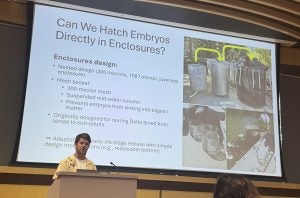
Abstract: The Fish Conservation and Culture Laboratory (FCCL) currently produces approximately 125,000 Delta Smelt annually, with plans to scale to 500,000 by Water Year 2030. To support this effort and address the low recapture rates observed in traditional release strategies, we explored two complementary supplementation approaches aimed at increasing production capacity, reducing handling stress, and enhancing post-release survival. River-based early-life stage release trials tested whether embryos could be hatched directly in river enclosures, bypassing intensive hatchery labor and transport related stress. Results showed that embryos successfully hatched in mesh enclosures without manual intervention; however, post-hatch survival was highly sensitive to temperature and resource availability, highlighting the need for winter – early spring deployments (Jan-Mar) to avoid seasonal thermal stress. Impoundment-based rearing was evaluated as a parallel culture system outside the hatchery. Using floating cages in Bouldin Island impoundments, Delta Smelt were reared from fall through spring under ambient conditions. Fish demonstrated strong survival and natural growth without supplemental feeding, suggesting this low-input approach can supplement FCCL while improving ecological fitness prior to release. These strategies provide scalable, cost effective pathways to supplement current hatchery operations and improve the viability of Delta Smelt recovery efforts. Ongoing studies will further assess whether impoundment reared fish exhibit improved fitness traits critical to post-release survival.
Feasibility of Acoustic Telemetry in Delta Smelt: Lessons After Two Years of Progress, Sebastian Gonzales

Abstract: Fish movement and survival are key metrics for evaluating the success of supplementary releases of cultured Delta smelt. In addition to net sampling, acoustic telemetry offers an independent and non-lethal way to gather course-scale information on survival, movement, and distribution, as well as fine-scale information on habitat use and movement behavior under various water operation scenarios. Prior to implementing acoustic tagging of Delta smelt in natural waterways, it is imperative to understand mortality and tag retention rates associated with tagging, transport, and release, as well as sublethal impacts associated with a tag burden. Using cultured adult Delta smelt we evaluated whether a newly miniaturized acoustic transmitter (0.05g) developed by the Pacific Northwest National Laboratory can be surgically implanted while minimizing mortality and adverse effects on Delta smelt. We evaluated various modifications to traditional salmonid handling, tagging, and post-surgical recovery protocols, and identified a minimum size threshold for tagging. These data will inform future studies using acoustic tagged Delta smelt to provide wildlife and water resource managers key information about movement behavior, survival, and habitat use. Such information has the potential to inform the refinement of supplemental release strategies, boost the efficiency of agency monitoring programs and identify habitat restoration locations in order to aid in the recovery of this critically endangered species.
Endurance Swimming to Inform Entrainment Risk for Native California Fishes, Kelly Hannan

Abstract: The San Francisco–San Joaquin watershed is one of the most heavily managed aquatic systems in California, where thousands of water diversions, annual dredging operations, and large-scale pumping facilities alter natural flow regimes. These anthropogenic activities can lead to the entrainment of sensitive native species, including juvenile Green and White Sturgeon (Acipenser medirostris, A. transmontanus), Chinook Salmon (Oncorhynchus tshawytscha), and Delta Smelt (Hypomesus transpacificus). To better understand species and life stage vulnerability to entrainment, we conducted fixed-velocity endurance swimming trials at several temperatures and fish life stages. From these trials, we developed endurance curves describing time-to-fatigue (min) across multiple test velocities. We then integrated these data with observed swimming behaviors (e.g., rheotaxis, benthic orientation) to estimate entrainment risk across a range of anthropogenic intake flow velocities. Results indicate that cooler temperatures increase the risk of entrainment in both sturgeon species compared to warmer test conditions, while Chinook Salmon of comparable size to sturgeon and Delta Smelt demonstrate stronger swimming abilities overall. These differences highlight the importance of species- and size-specific thresholds when developing operational guidance for flow management. By linking laboratory-derived swimming performance data with hydraulic conditions in the field, this work provides a quantitative framework for estimating entrainment risk. These findings can inform management decisions regarding flow rates at water diversions, pumping facilities, and dredging operations to minimize entrainment of threatened native fishes and support their conservation.
Building Capacity for Longfin Smelt Recovery: Collaborative Culture Efforts Across UC Davis Facilities, Kendall Ashley & Zoe Kimball
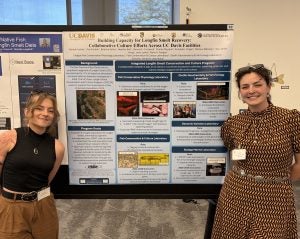
Abstract: Longfin Smelt (Spirinchus thaleichthys), once one of the most abundant osmerids in the San Francisco Estuary, was listed as endangered under the Endangered Species Act in July 2024. Today, the population stands at less than 1% of historical levels due to habitat degradation, altered freshwater flows, food limitation, climate change, and small population dynamics. To address this decline, the UC Davis Longfin Smelt Conservation and Culture Program (LFSCCP), supported by the California Department of Water Resources, integrates four specialized facilities to advance full life-cycle culture and recovery. The Otolith Geochemistry and Fish Ecology Laboratory (OGFL) leads broodstock collection from South Bay and Alviso Marsh, ensuring genetic diversity and healthy spawner acquisition. The Fish Conservation and Culture Laboratory (FCCL) focuses on spawning and early life stages, refining fertilization, incubation, and larval rearing protocols. The Putah Creek Facility (PCF) provides large-scale capacity for juvenile and adult culture, with recirculating aquaculture systems (RAS) supporting all life stages. Finally, the Bodega Marine Laboratory (BML) supports rearing of Longfin Smelt under full-strength seawater conditions, with new systems under construction to expand capacity. This poster presents the integrated culture framework developed by the LFSCCP, highlighting protocols for broodstock transport and conditioning, fertilization and larval rearing methods, and system design innovations supporting all life stages. Cross-facility coordination strategies and genetic management approaches will also be described to inform future recovery efforts. Results from 2024-2025 demonstrate the effectiveness of this framework: increased broodstock collections and improved transport survival from OGFL, higher hatching and larval success at FCCL, successful rearing of age-2 F1 fish at PCF, successful spawning of wild age-2 adults at BML, and new infrastructure at both PCF and BML to expand capacity. Together, these facilities form a collaborative network advancing Longfin Smelt culture science, increasing captive capacity, and building the foundation for long-term species recovery.